

Assessor and Remediator Are Not the Same Role
A mold removal specialist can mean two things. An assessor inspects, reads moisture, sometimes samples air or surfaces, and writes a protocol. A remediator carries out the physical work, which is the core of mold remediation: containment, removal, cleaning and drying.
Many owners prefer to keep those roles apart. If one company tests, scopes, removes and then decides whether its own work passed, nobody is checking the result. An independent assessor who has no stake in the removal can review the finished work and write a clearance report.
Some callers phone us wanting only the testing, and others want only the removal. Both are reasonable requests, and we will tell you plainly which part of the job we handle.
What California Does and Does Not License
The California Department of Public Health states that California has no regulations for licensing mold remediators. In other words, no state mold license exists to ask for.
Separately, the Contractors State License Board sets licensing triggers for any trade: a building permit, employees on the job, or a combined labor and materials value of $1,000 or more. The CSLB pages we reviewed do not address mold work specifically, so we cannot say which classification applies to a given job. Ask the company what license it holds and for which scope, then look it up on the CSLB site.
Treat any claim of a state mold certification with caution, because the state source above says there is no licensing program. Trade-group training can be useful, but it is not a government license.
Comparing bids for mold work?
Call the 24/7 line and ask us any question on the checklist below. We will explain our scope and our process before any work begins.
Hiring for Mold Work in Reseda: What California Agencies Say
CDPH's mold FAQ says California has no regulations for licensing mold remediators. The state contractor board (CSLB) has a disaster-guidance page that tells consumers to verify a license at cslb.ca.gov or by phone at (800) 321-2752, and jobs of $1,000 or more fall under its licensing rule. Together, these sources point to a practical step: check the contractor's CSLB record rather than looking for a mold-specific credential.
CSLB also advises getting three bids and a written contract and limiting the down payment. Because 46.2 percent of households in the surrounding planning area rent, many requests start with a tenant whose landlord has agreed to a repair. If that is you, ask the landlord who is contracting and who holds the paperwork.
CDPH also says mold testing is not recommended when mold is visible or smelled. Save lab work for the point after remediation, when an independent assessor checks the result.
Sources: CDPH mold frequently asked questions, CSLB what kind of contractor do I need, CSLB disaster help center, EPA mold cleanup in your home, City Planning Reseda profile
Questions to Put to Any Mold Company
| Question | A good answer includes | A weak answer |
|---|---|---|
| Do you follow ANSI/IICRC S520? | Names the standard and explains containment and air filtration | Vague references to proprietary methods |
| What license do you hold? | A CSLB license number you can verify at cslb.ca.gov | A claim of state mold certification |
| Is the scope in writing? | Area, materials removed, containment, drying and finishing steps | A single line item with no detail |
| Who finds the moisture source? | Says the leak must be fixed before or alongside removal | Treats the visible patch as the whole job |
| Who checks the result? | Welcomes an independent assessor | Insists on testing its own work |
| How are deposits handled? | Follows CSLB guidance on down payments | Wants a large payment upfront |
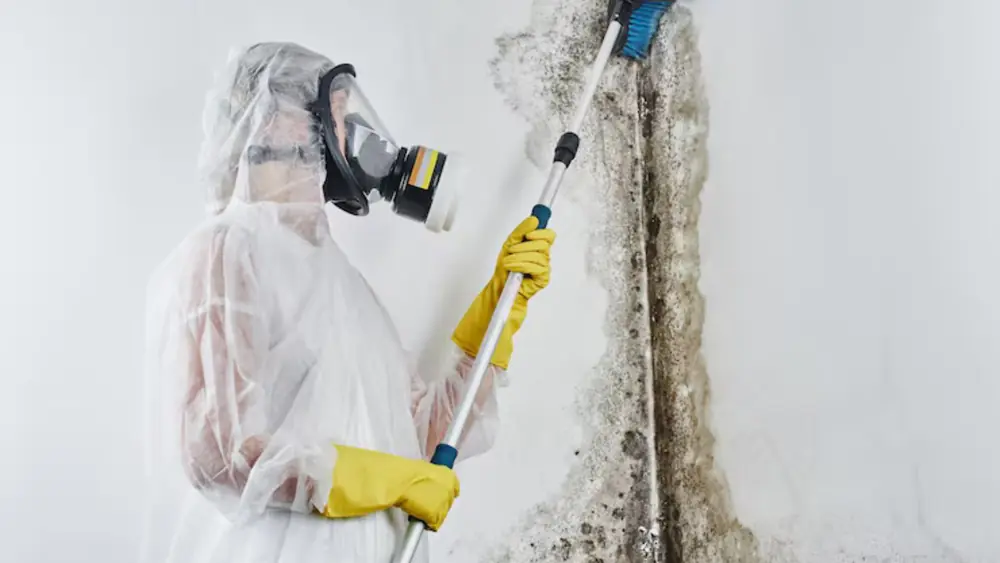
What a Competent Remediation Crew Brings to the Door
Moisture meter and camera
A pro measures first. A thermal imaging camera and a moisture meter locate wet materials that are not visible.
Containment materials
Poly sheeting, zipper doors, and negative air pressure keep disturbed particles inside the work zone.
HEPA air scrubbers
These machines filter air in the work area, and HEPA vacuums clean framing without blowing dust around.
Drying equipment
Air movers and LGR dehumidifiers dry the structure afterward, which links mold work to water damage cleanup when a leak caused the problem.
EPA says a mold contractor should have experience and follow EPA, ACGIH or IICRC guidelines. Ask for the guideline by name and whether a copy of the written protocol can be shared before work begins.
How the Scope and Price Are Set
Callers often want a quote on the first call. A responsible company cannot price mold removal from a sentence over the phone, because the price depends on what an inspection finds: affected area, material types, access, containment zones, equipment days and rebuild needs.
Look for a written scope that you can compare line by line. Rushing is the habit CSLB warns against. Its advice is to collect multiple bids, sign a written contract, and keep the deposit small, capped at the lesser of 10 percent or $1,000. Our own process is to explain scope and price before work starts, and nothing begins without your agreement.
Clearance Testing When a Sale or Loan Is Involved
When a buyer's lender or a property manager asks for proof that mold was handled, the usual paper is a clearance report from an assessor who is independent of the remediator. It documents that the work area was inspected after removal and drying.
We cannot tell you what a particular lender, buyer or landlord will accept. Ask them for their requirements in writing before you hire anyone. Companies serving nearby neighborhoods such as Encino and Woodland Hills face the same sale-related requests.
Frequently Asked Questions
Does California license mold removal specialists?
California has no licensing regulations for mold remediators, CDPH states. Contractor licensing still applies to jobs at the $1,000 level and above, so ask what license the company holds and verify it at cslb.ca.gov.
Should the company that removes the mold also test it?
Many owners prefer an independent assessor for clearance so nobody grades their own work. An independent assessor is a separate business from the remediator.
If I am selling a Reseda home, is a clearance report enough for the buyer's lender?
We cannot say. Lenders set their own requirements, so ask the lender and your agent what they need before work starts.
Is a lower bid always the same job?
No. Compare the written scopes for containment, material removal, drying and finishing. A low number that leaves out containment is not the same service.
What do you do first when I call?
We ask where the moisture came from, what you can see, and how large the area is. Then we set an inspection and explain the scope before work starts.
Water still spreading? Call the 24/7 line at (818) 337-2642.